Sand vs Cartridge vs DE Pool Filters
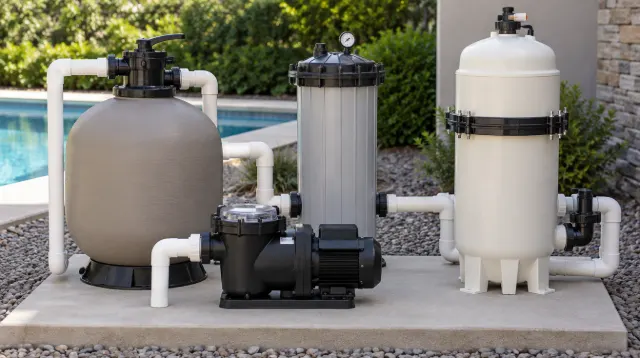
Sand, cartridge and DE pool filters compared: how fine they filter, cleaning, water use, cost and lifespan, plus how to tell when your filter needs attention.

Saltwater or traditional chlorine? How salt chlorine generators work, upfront and running costs, maintenance, feel of the water, and which suits your pool.
The saltwater vs chlorine debate is often framed as “chemicals vs natural”. In reality, both are chlorine pools. The difference is how the chlorine gets into the water, and that changes cost, maintenance and how the water feels.
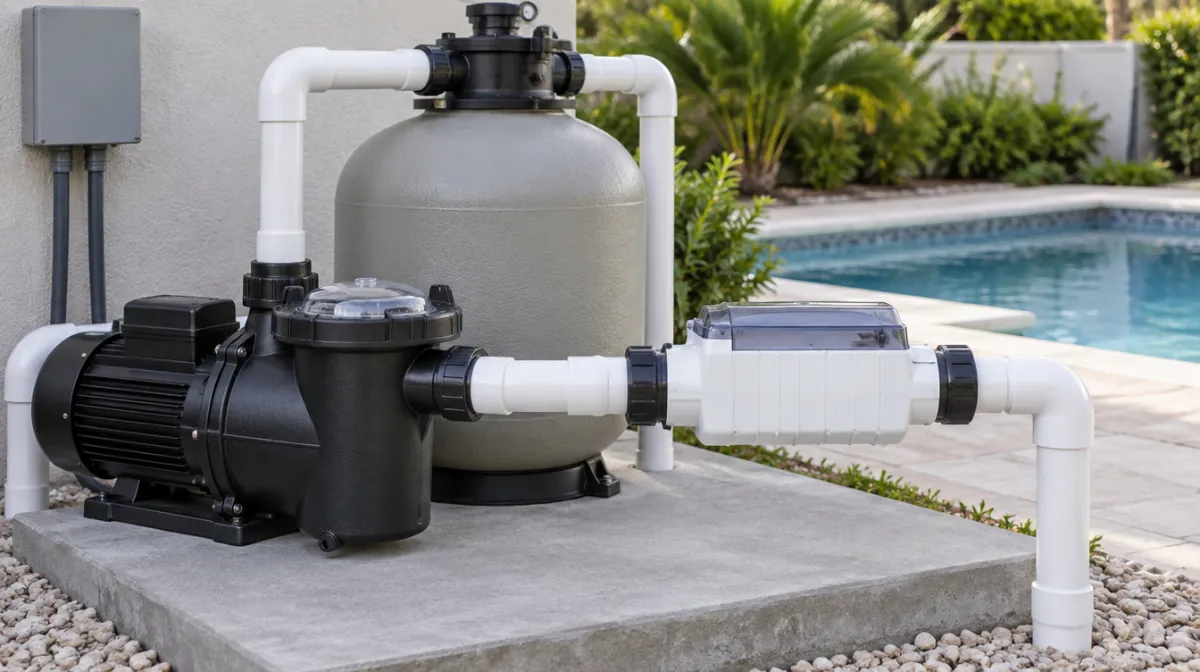
A saltwater pool has salt dissolved in the water, usually around 3,000 ppm, far less salty than the sea. As water flows through a salt cell, a small electric current converts some of the salt into chlorine, which sanitizes the pool before turning back into salt.
| Saltwater (salt chlorine generator) | Traditional chlorine | |
|---|---|---|
| Upfront cost | Higher: generator and cell | Low |
| Ongoing chemical cost | Lower: mainly salt and acid | Higher: regular chlorine purchases |
| Chlorine delivery | Steady, automatic | Manual or via a tablet feeder |
| Water feel | Often described as softer | Varies with chemistry |
| pH | Tends to rise; needs regular acid | More stable, depending on products |
| Maintenance | Clean the cell; replace it every few years | Buy, store and add chlorine |
| Corrosion risk | Salt can affect some stone, metal and equipment | Lower |
Traditional chlorine is cheaper to set up and simpler to repair. The trade-off is buying and handling chlorine regularly, and, if you rely on stabilized tablets, managing stabilizer build-up; see our cyanuric acid guide.
Either way, the same chemistry targets apply, and safety matters just as much; our pool safety guide covers the layers every family pool needs.
Yes. The salt cell produces chlorine from salt. Free chlorine levels are similar to a traditional pool.
Most generators need roughly 2,700–3,400 ppm. Follow your cell manufacturer’s range.
Usually, by adding a salt chlorine generator and salt. Check that your equipment, surfaces and local rules are compatible first.

Every article is edited by a human and checked against our editorial policy. Spotted a mistake? Tell us.
Sand, cartridge and DE pool filters compared: how fine they filter, cleaning, water use, cost and lifespan, plus how to tell when your filter needs attention.
What to look for in a robotic pool cleaner: wall and waterline cleaning, filtration, navigation, cable or cordless, maintenance and warranty.
Heat pump, gas or solar pool heater? How each works, running costs, heating speed, climate fit and sizing, plus why a pool cover is the cheapest upgrade of all.