Pool Volume Calculator: How Many Gallons Is My Pool?
Work out how many gallons your pool holds in seconds. Free pool volume calculator for rectangle, round and oval pools, plus the formulas and measuring tips.

Ideal pool chemistry levels in one chart: pH, free chlorine, alkalinity, calcium, stabilizer and salt, plus what to adjust first and a volume calculator.
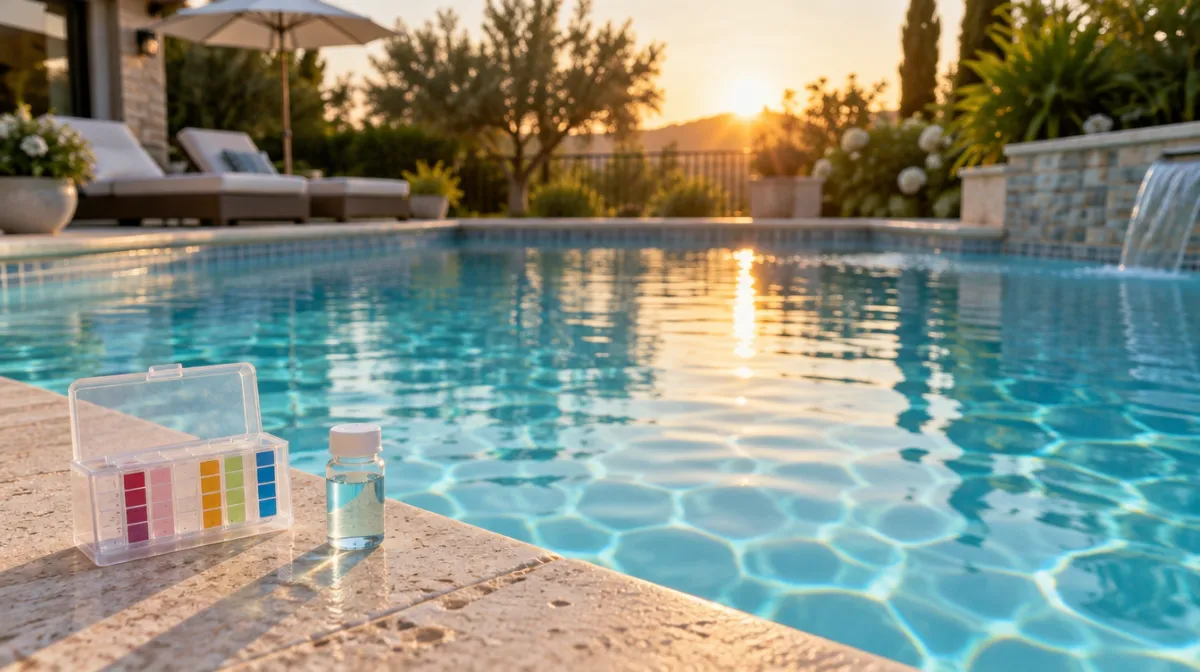
Clear, comfortable pool water isn’t luck. It comes down to a handful of readings kept inside the right ranges. Get them right and chlorine works efficiently, swimmers’ eyes don’t sting and your plaster, liner and heater last longer. Get them wrong and you pay for it in chemicals, cloudy water and repairs.
The good news: you only need to understand seven numbers, and three of them do most of the work.
| Reading | Ideal range | Why it matters |
|---|---|---|
| Free chlorine (FC) | 1–3 ppm (more with higher stabilizer) | Kills bacteria and algae |
| pH | 7.4–7.6 (acceptable 7.2–7.8) | Controls chlorine strength and swimmer comfort |
| Total alkalinity (TA) | 80–120 ppm | Buffers pH so it doesn’t swing |
| Calcium hardness (CH) | 200–400 ppm for plaster; about 150–250 ppm for vinyl and fiberglass | Protects plaster and prevents scale |
| Cyanuric acid (CYA, stabilizer) | 30–50 ppm (60–80 ppm for saltwater pools) | Shields chlorine from sunlight |
| Combined chlorine (CC) | Below 0.5 ppm, ideally zero | Chloramines cause the “chlorine smell” |
| Salt (saltwater pools only) | Usually 2,700–3,400 ppm; follow your cell’s manual | Feeds the chlorine generator |
Free chlorine is the sanitizer that is still available to do its job. The CDC recommends at least 1 ppm in pools (3 ppm in hot tubs; our hot tub chemistry basics cover spa care). In a sunny outdoor pool with stabilizer, aim for the upper end of the range, or use the 7.5% rule above.
pH decides how aggressive your chlorine is and how the water feels. Below 7.2, water becomes corrosive and stings eyes. Above 7.8, chlorine loses much of its punch and scale starts forming. Most pools drift upward over time, especially saltwater pools, so expect to add acid now and then.
Alkalinity is pH’s shock absorber. Too low and pH bounces around; too high and pH keeps creeping up no matter how much acid you add. Once it sits between 80 and 120 ppm, it rarely needs attention.
Chemicals interact, so order matters. Work through them one at a time and retest between steps:
Take samples from elbow depth, away from return jets and skimmers. In swimming season, test free chlorine and pH two to three times a week, and alkalinity, calcium and stabilizer every couple of weeks.
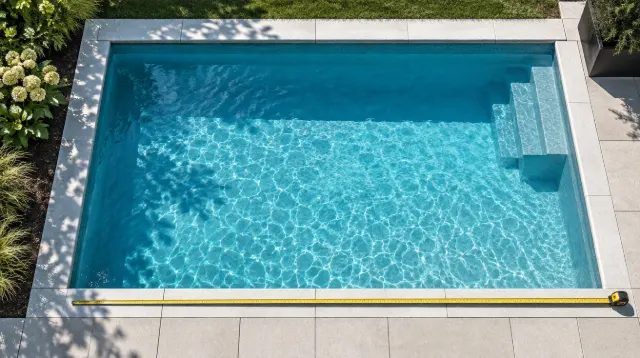
Every dose depends on how many gallons your pool holds, so start by working out your volume.
Measure in feet. For a sloped floor, use the average of the shallow and deep ends.
With your volume known, follow the dosing directions on the product label. A handy benchmark for liquid chlorine: one gallon of 10% liquid chlorine raises free chlorine by roughly 10 ppm in 10,000 gallons of water.
| What you see | Likely cause |
|---|---|
| Cloudy or dull water | Low chlorine, high pH or alkalinity, or poor filtration |
| Green tint or slippery walls | Algae growing because chlorine is too low |
| Stinging eyes, strong “chlorine” smell | Combined chlorine (chloramines) or pH out of range |
| White crust at the waterline | High pH together with high calcium |
| Etched plaster, corroded metal | pH or alkalinity too low |
If your pool has already turned green, follow our step-by-step guide to fixing a green pool.
And because chemistry is only half of a safe pool, read our guide to the layers of protection every family pool needs.
It is at the top of the acceptable range. The water is still swimmable, but chlorine works noticeably less well, so bring it back toward 7.5.
That smell usually means too little free chlorine, not too much. It comes from chloramines, which form when chlorine reacts with sweat and other contaminants. Shocking the pool breaks them down.
Test free chlorine and pH two to three times a week in season, and after heavy use or storms. Test the other readings every two weeks or so.

Every article is edited by a human and checked against our editorial policy. Spotted a mistake? Tell us.
Work out how many gallons your pool holds in seconds. Free pool volume calculator for rectangle, round and oval pools, plus the formulas and measuring tips.
Why pool pH rises, how to lower it safely with muriatic acid or dry acid, how much to add, and how to stop it creeping back up. Step by step, with safety tips.
Low alkalinity makes pH bounce around and water corrosive. How to raise total alkalinity with baking soda, how much to add and how it differs from raising pH.