Pool Chemistry Basics: The Ideal Levels Chart
Ideal pool chemistry levels in one chart: pH, free chlorine, alkalinity, calcium, stabilizer and salt, plus what to adjust first and a volume calculator.

What cyanuric acid does, the ideal stabilizer level for your pool, why too much makes chlorine weak, how to raise it and the only reliable way to lower it.
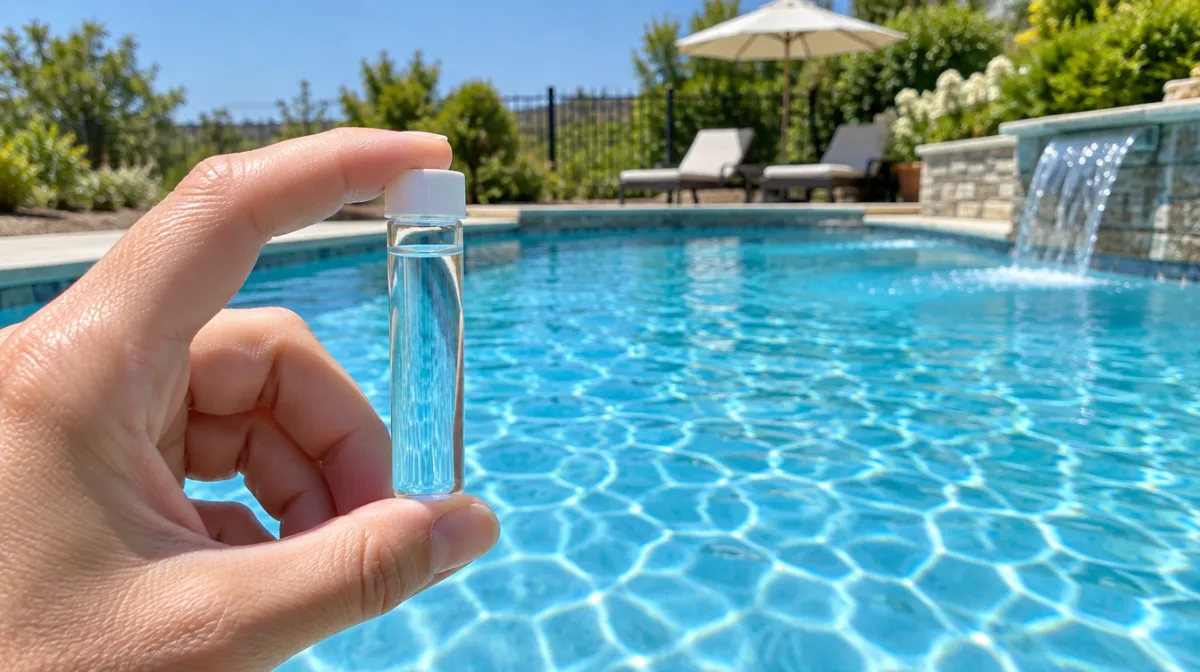
Cyanuric acid (CYA), often sold as stabilizer or conditioner, is what lets chlorine survive a sunny day. Without it, sunlight can destroy most of the chlorine in an outdoor pool within hours. But too much stabilizer creates its own problem: chlorine that is too slow to keep the water clean.
CYA binds loosely with chlorine, shielding it from ultraviolet light. The trade-off is that bound chlorine works more slowly. So as stabilizer goes up, you need more free chlorine to get the same sanitizing power.
| Pool type | Target CYA |
|---|---|
| Outdoor chlorine pool | 30–50 ppm |
| Outdoor saltwater pool | 60–80 ppm (check your cell’s guidance) |
| Indoor pool | Often little or none needed |
A widely used rule is to keep free chlorine at about 7.5% of your CYA level: at 40 ppm CYA, that’s roughly 3 ppm free chlorine. See the full pool chemistry chart.
Add stabilizer granules or liquid according to the label, usually dissolved slowly via the skimmer or a sock in front of a return. It can take several days to register fully on a test.
There is no reliable chemical that removes stabilizer in a normal pool. The practical fix is dilution: partially drain and refill with fresh water. To halve CYA, replace roughly half the water. Check local rules and your pool type before draining, and never fully drain a pool without professional advice, as some pools can be damaged.
Stabilized chlorine products, trichlor tablets and dichlor shock, add CYA every time you use them. Over a season, levels can climb far above target. Using liquid chlorine or a salt system for part of your chlorine avoids the build-up.
No. It is a separate chemical that protects chlorine from sunlight.
Yes. If free chlorine isn’t raised to match high stabilizer, algae can grow. Our green pool guide explains the fix.
Every few weeks in season, and after adding stabilized products or draining and refilling.

Every article is edited by a human and checked against our editorial policy. Spotted a mistake? Tell us.
Ideal pool chemistry levels in one chart: pH, free chlorine, alkalinity, calcium, stabilizer and salt, plus what to adjust first and a volume calculator.
Work out how many gallons your pool holds in seconds. Free pool volume calculator for rectangle, round and oval pools, plus the formulas and measuring tips.
Why pool pH rises, how to lower it safely with muriatic acid or dry acid, how much to add, and how to stop it creeping back up. Step by step, with safety tips.