Saltwater vs Chlorine Pools: Costs, Pros and Cons
Saltwater or traditional chlorine? How salt chlorine generators work, upfront and running costs, maintenance, feel of the water, and which suits your pool.

Sand, cartridge and DE pool filters compared: how fine they filter, cleaning, water use, cost and lifespan, plus how to tell when your filter needs attention.
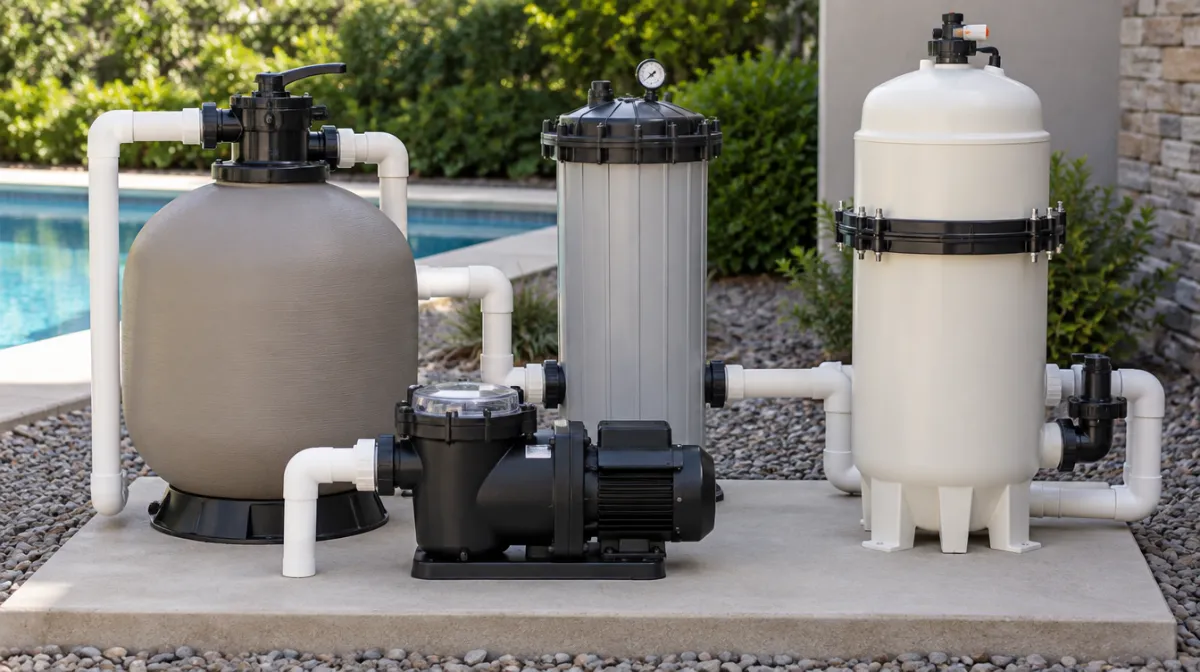
Your filter does the physical cleaning your chemicals can’t: it strains out dirt, dead algae and the fine particles that make water dull. The three main types each trade off filtration quality, maintenance and cost.
| Sand | Cartridge | DE (diatomaceous earth) | |
|---|---|---|---|
| Filtration | Good | Better | Best |
| Cleaning | Backwash | Remove and hose off | Backwash and recharge with DE powder |
| Water use | Higher (backwashing) | Low | Moderate |
| Upfront cost | Lowest | Medium | Highest |
| Media lifespan | Sand every 5–7 years or so | Cartridges every 1–3 years or so | DE added after each backwash; grids last years |
| Best for | Low-maintenance owners | Water-conscious owners, smaller pools | Owners who want the clearest water |
Water flows through a tank of special filter sand that traps debris. When pressure rises, you backwash, reversing the flow to flush dirt out to waste. The same waste setting is used when you vacuum a pool full of fine debris. Sand filters are simple, durable and forgiving, but they don’t catch the finest particles, and backwashing uses a lot of water. Some owners use glass media as an alternative to sand.
Water passes through pleated fabric cartridges. To clean them, you remove the cartridges and hose them off, and soak them in cartridge cleaner a few times a season. They filter finer than sand and use little water, but cleaning is hands-on.
DE filters use grids coated with diatomaceous earth, a powder made of fossilised microscopic algae. They catch the finest particles of all, giving exceptionally clear water. The trade-offs: more complex maintenance, regular DE additions and care handling the powder. Wear a mask when adding DE, and check local rules on disposing of it.
Note the pressure gauge reading when the filter is clean. When it rises about 8–10 psi above that, it’s time to backwash or clean. Other signs: weak return flow, cloudy water that won’t clear and a pump that sounds strained. Our guide to cloudy pool water covers the full checklist.
Enough to turn the full volume of water over at least once a day, often around eight hours, more in hot weather or heavy use. Work out your volume with our pool volume calculator.
A robotic cleaner can reduce the load on any filter; see our robotic pool cleaner buying guide.
Sand filters are usually the easiest: backwashing takes a few minutes.
Often, yes, if the new filter is sized correctly for your pump and pool. Ask a pool professional to check the plumbing and flow rates.
Whenever pressure rises 8–10 psi above clean, and with a deep clean a few times each season.

Every article is edited by a human and checked against our editorial policy. Spotted a mistake? Tell us.
Saltwater or traditional chlorine? How salt chlorine generators work, upfront and running costs, maintenance, feel of the water, and which suits your pool.
What to look for in a robotic pool cleaner: wall and waterline cleaning, filtration, navigation, cable or cordless, maintenance and warranty.
Heat pump, gas or solar pool heater? How each works, running costs, heating speed, climate fit and sizing, plus why a pool cover is the cheapest upgrade of all.