Pool Chemistry Basics: The Ideal Levels Chart
Ideal pool chemistry levels in one chart: pH, free chlorine, alkalinity, calcium, stabilizer and salt, plus what to adjust first and a volume calculator.

Drowning is fast and silent. The layers that protect children at home pools: four-sided fencing, alarms, water watchers, swim lessons, CPR and safe drains.
Drowning doesn’t look like it does in films. There is rarely splashing or shouting. A young child can slip under the surface silently in the time it takes to answer a message. According to the CDC, drowning is the leading cause of death for children aged one to four in the United States, and most of those drownings happen in home swimming pools.
Safety experts talk about layers of protection because every single measure can fail. A gate gets propped open. A supervising adult gets distracted. The more layers you have, the less any one failure matters.
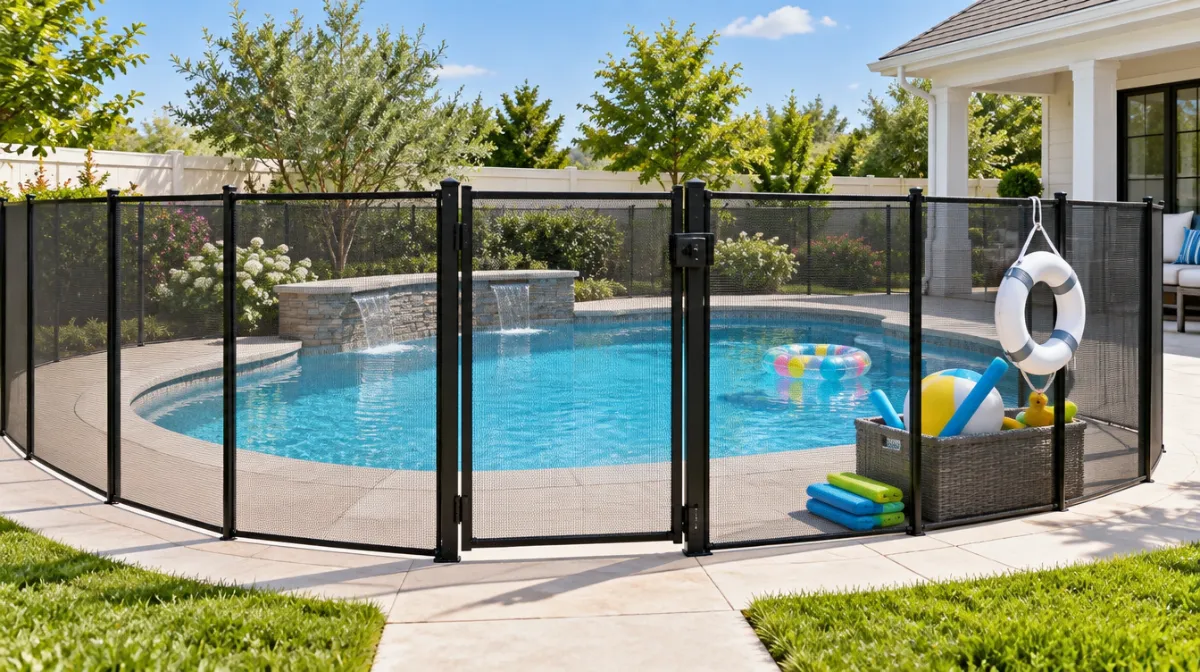
The most effective physical barrier is a fence that completely separates the pool from the house and the rest of the yard. A fence around the property line with the house forming one side still lets a child walk straight from the back door to the water.
Look for:
Check the gate every time you use the pool. A self-closing gate is only useful if it actually closes.
Door alarms on any door that leads to the pool area give you a warning if a child slips outside. Pool alarms that detect a disturbance in the water add another layer. A power safety cover that meets the ASTM F1346 standard can block access completely when the pool is not in use. A floating solar cover, on the other hand, is not a safety cover and can be dangerous if a child gets underneath it. A standard winter cover isn’t a safety cover either, so keep gates latched and ladders removed after you winterize the pool.
When children are in or near the water, one adult should do nothing but watch them. Not cooking, not chatting, not scrolling.
Crowded pool parties are when supervision fails most often, because everyone assumes someone else is watching.
Formal swim lessons reduce drowning risk, and the American Academy of Pediatrics notes that many children can start lessons from around age one. Choose lessons that teach water competency: getting back to the surface, turning, floating and reaching the edge.
Lessons are an important layer, but they never make a child “drown-proof”. Every other layer still applies.
Every adult and teen who looks after children around water should know CPR. Starting CPR immediately, before emergency services arrive, can make the difference between life and death. Local courses run by organisations such as the American Red Cross take a few hours. Keep a phone and a rescue aid, such as a reaching pole or ring buoy, by the pool.
Powerful suction from pool drains can trap hair, limbs or swimsuits. Since the Virginia Graeme Baker Pool and Spa Safety Act, public pools and spas in the US must use anti-entrapment drain covers. At home, check that your drain covers are compliant, secure and undamaged each time you open the pool for the season, and make sure every adult knows where the pump’s emergency shut-off is.
Check the pool first, including the bottom and under any cover. Seconds matter. If you find a child in the water, get them out, call 911 (or have someone else call) and start CPR.
Yes. Empty small inflatable pools after every use and store them upside down. For above-ground pools, remove or lock the ladder when no one is swimming.
There is no age at which supervision stops mattering. Even strong swimmers can be injured or get into difficulty. Adjust how close you stand, but always keep someone watching.
No. Inflatable arm bands and toys can slip off or deflate. If a child needs flotation, use a properly fitted, approved life jacket, and still supervise closely.

Every article is edited by a human and checked against our editorial policy. Spotted a mistake? Tell us.
Ideal pool chemistry levels in one chart: pH, free chlorine, alkalinity, calcium, stabilizer and salt, plus what to adjust first and a volume calculator.
Turn a green pool clear again: test, brush, shock to the right level for your stabilizer, run the filter and vacuum. Doses, timelines and mistakes to avoid.
Work out how many gallons your pool holds in seconds. Free pool volume calculator for rectangle, round and oval pools, plus the formulas and measuring tips.