Pool Chemistry Basics: The Ideal Levels Chart
Ideal pool chemistry levels in one chart: pH, free chlorine, alkalinity, calcium, stabilizer and salt, plus what to adjust first and a volume calculator.

Why pool pH rises, how to lower it safely with muriatic acid or dry acid, how much to add, and how to stop it creeping back up. Step by step, with safety tips.
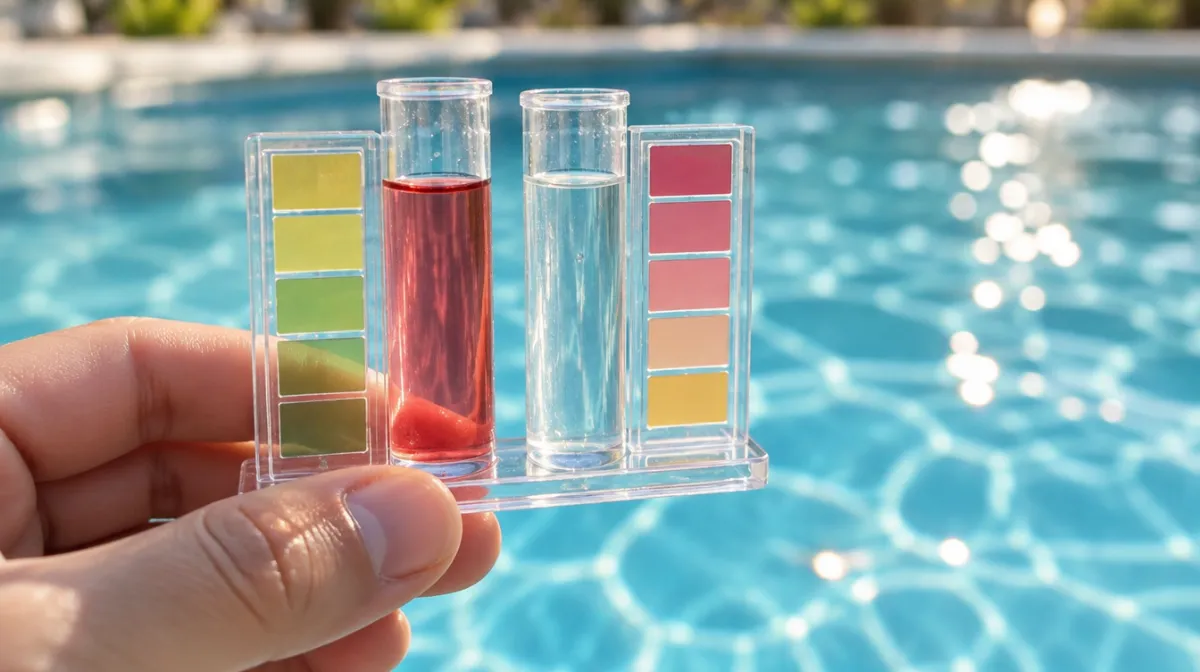
High pH is one of the most common pool problems, and one of the easiest to fix once you know how. When pH climbs above about 7.8, chlorine loses much of its strength, water turns dull and scale starts building on tiles and equipment.
| Product | Pros | Cons |
|---|---|---|
| Muriatic acid (hydrochloric acid) | Cheap, fast, widely used | Strong fumes; handle with great care |
| Dry acid (sodium bisulfate) | Easier to store and handle | Costs more; adds sulfates over time |
Both work. Most pool professionals use muriatic acid because it’s inexpensive and effective.
If pH climbs again within days, look at total alkalinity. Alkalinity above about 120 ppm keeps dragging pH up. Lowering alkalinity takes patience: add acid to bring pH down to around 7.0–7.2, then aerate the water (run fountains, point returns upward) to raise pH without raising alkalinity. Repeat until alkalinity falls; our guide to lowering total alkalinity walks through each round. Our guide to raising alkalinity explains the other side of the balance.
pH below 7.2 makes water corrosive, which can etch plaster, damage heaters and irritate eyes. If you do overshoot, our guide to raising pH shows how to bring it back up gently. Small doses and patient retesting are far better than one big pour.
Follow the product label. Many recommend waiting until the acid has circulated fully, often at least 30 minutes to a few hours, and until pH is back in range.
Vinegar is far too weak to be practical for a pool. Use muriatic acid or dry acid.
Liquid chlorine and calcium hypochlorite can raise pH slightly. Test and adjust after shocking.

Every article is edited by a human and checked against our editorial policy. Spotted a mistake? Tell us.
Ideal pool chemistry levels in one chart: pH, free chlorine, alkalinity, calcium, stabilizer and salt, plus what to adjust first and a volume calculator.
Work out how many gallons your pool holds in seconds. Free pool volume calculator for rectangle, round and oval pools, plus the formulas and measuring tips.
Low alkalinity makes pH bounce around and water corrosive. How to raise total alkalinity with baking soda, how much to add and how it differs from raising pH.