Pool Chemistry Basics: The Ideal Levels Chart
Ideal pool chemistry levels in one chart: pH, free chlorine, alkalinity, calcium, stabilizer and salt, plus what to adjust first and a volume calculator.

Work out how many gallons your pool holds in seconds. Free pool volume calculator for rectangle, round and oval pools, plus the formulas and measuring tips.
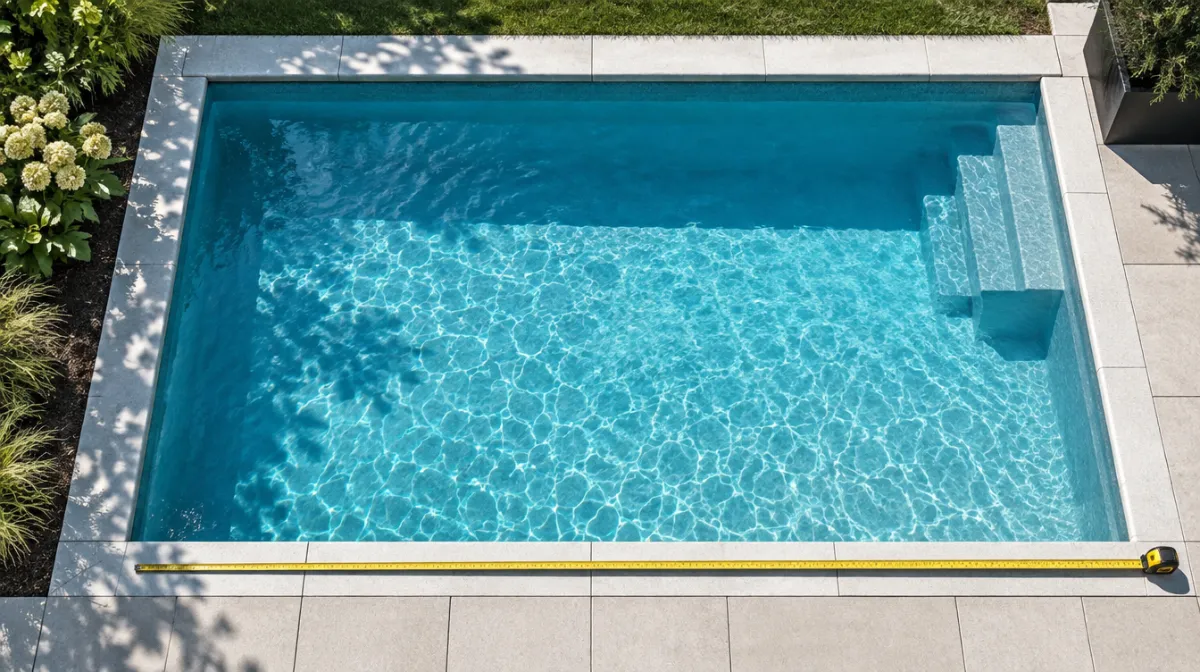
Every pool chemical dose, from chlorine to acid to stabilizer, is based on how much water your pool holds. Guess wrong and you either waste money or leave the water unbalanced. The calculator below gives you a reliable number in seconds.
Measure in feet. For a sloped floor, use the average of the shallow and deep ends.
| Pool shape | Formula (gallons) |
|---|---|
| Rectangle or square | Length × width × average depth × 7.48 |
| Round | Diameter × diameter × average depth × 5.9 |
| Oval | Length × width × average depth × 5.9 |
| Kidney or freeform | Length × width × average depth × 6.7 (approximate) |
The 7.48 comes from the number of gallons in a cubic foot of water. The round and oval factors account for the curved sides.
A 32 × 16 ft rectangular pool, 3.5 ft deep at the shallow end and 8 ft at the deep end:
Once you know your gallons, you can dose accurately, and our pool chemical dosage calculator turns your test results into amounts. Our pool chemistry chart shows the target levels, and our guides to lowering pH and how much shock your pool needs show how to adjust them.
Many in-ground residential pools hold somewhere between 15,000 and 30,000 gallons, but sizes vary widely. Measure yours rather than relying on an average.
For regular shapes, very close. For freeform pools, treat the result as an estimate and adjust doses cautiously, retesting after each addition.
Multiply gallons by 3.785. The calculator shows both.

Every article is edited by a human and checked against our editorial policy. Spotted a mistake? Tell us.
Ideal pool chemistry levels in one chart: pH, free chlorine, alkalinity, calcium, stabilizer and salt, plus what to adjust first and a volume calculator.
Why pool pH rises, how to lower it safely with muriatic acid or dry acid, how much to add, and how to stop it creeping back up. Step by step, with safety tips.
Low alkalinity makes pH bounce around and water corrosive. How to raise total alkalinity with baking soda, how much to add and how it differs from raising pH.