Cloudy Pool Water: Causes and Fixes
Why pool water turns cloudy and how to clear it: low chlorine, high pH or alkalinity, poor filtration, high calcium, early algae and debris, with fixes.

Turn a green pool clear again: test, brush, shock to the right level for your stabilizer, run the filter and vacuum. Doses, timelines and mistakes to avoid.
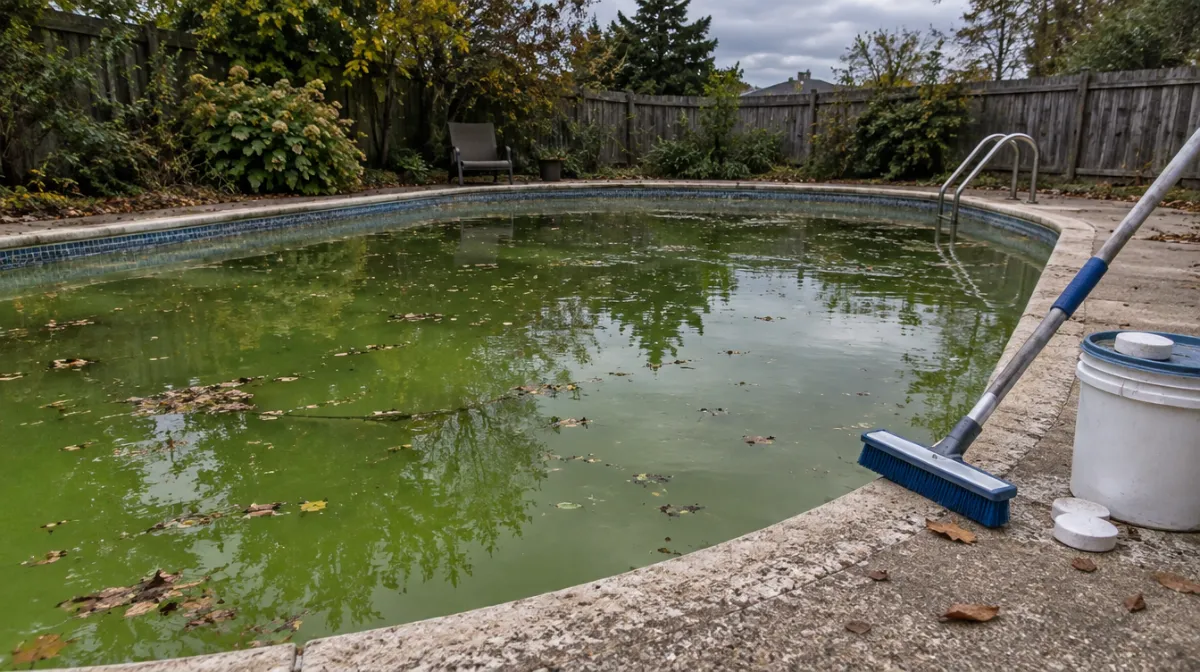
A green pool looks like a disaster, but it is almost always fixable without draining. Green water means algae, and algae grows when free chlorine drops too low for too long, usually after a heatwave, a storm, a pump failure or a week away.
The fix is simple in principle: raise chlorine high enough to kill the algae, keep it there until every trace is gone, and let your filter clear the debris. Here is how to do it properly, in order.
Test free chlorine, pH and cyanuric acid (stabilizer). The stabilizer reading is the one most people skip, and it decides how much chlorine you need.
If cyanuric acid is above about 80–90 ppm, chlorine struggles to work at any practical dose. In that case, partially drain and refill first to bring it down.
Scoop out leaves and debris so they don’t use up your chlorine. Then brush the walls, floor, steps and behind ladders. Brushing breaks up the protective layer algae forms and exposes it to chlorine. Brush at least once a day until the pool is clear.
Aim for a pH of 7.2–7.6 before shocking. Chlorine is far more effective at the lower end of the range, so a pool at pH 8.0 will take much longer to clear.
Shocking just means raising free chlorine well above normal. The target depends on your stabilizer. A widely used approach is to raise free chlorine to about 40% of your cyanuric acid level and hold it there.
| Cyanuric acid | Shock target (free chlorine) |
|---|---|
| 30 ppm | 12 ppm |
| 40 ppm | 16 ppm |
| 50 ppm | 20 ppm |
| 70 ppm | 28 ppm |
Liquid chlorine (sodium hypochlorite) is the best choice for this. Chlorine tablets and granular dichlor add more stabilizer every time you use them, and calcium hypochlorite adds calcium, which causes problems at the large doses a green pool needs.
How much to add: one gallon of 10% liquid chlorine raises free chlorine by roughly 10 ppm in 10,000 gallons. For a 20,000-gallon pool at 40 ppm stabilizer, going from zero to 16 ppm takes about 3.2 gallons. Not sure of your volume? Use the calculator in our pool chemistry chart.
Run the pump 24 hours a day until the water is clear. Clean or backwash the filter whenever pressure rises about 8–10 psi above its clean reading. On a badly green pool, that may be daily. Cartridge filters often need hosing off more than once.
As the algae dies, the water turns from green to blue-grey and dead algae settles on the floor. Vacuum it up (our guide to vacuuming a pool manually covers priming and valve settings). If your system allows it, vacuum to waste so the debris bypasses the filter entirely, then top the pool back up.
Keep holding the shock level until the pool passes all three of these checks:
Then let chlorine fall back to your normal range and rebalance.
Flocculant clumps fine particles so they sink to the floor, which can clear a pool faster. It only works if you then vacuum to waste, and it doesn’t kill algae on its own.
Algaecide is better for prevention than cure. If you use one, polyquat-based products are less likely to foam or stain than copper-based ones, which can leave blue-green marks on plaster and turn blonde hair green.
Usually two to seven days. Very dark green or black-green pools, pools with high stabilizer and pools with weak filtration take longer.
Cloudiness after shocking is usually dead algae and fine debris. Keep the filter running, clean it often and keep chlorine at shock level until the water clears.
Tablets dissolve slowly and add stabilizer each time, which makes future algae more likely. Use liquid chlorine to clear the pool, then return to your normal routine.

Every article is edited by a human and checked against our editorial policy. Spotted a mistake? Tell us.
Why pool water turns cloudy and how to clear it: low chlorine, high pH or alkalinity, poor filtration, high calcium, early algae and debris, with fixes.
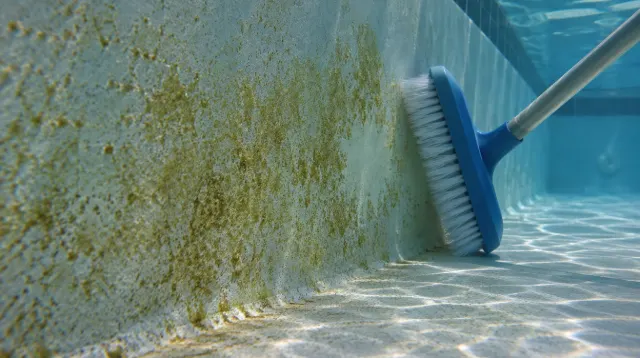
Yellow, dusty patches that brush away and come back? How to identify and kill mustard algae, clean everything it touches and stop it returning.
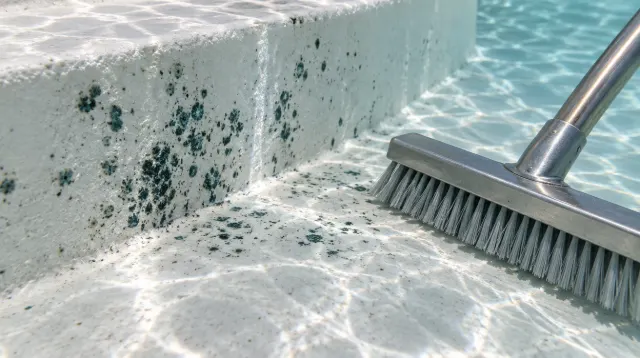
How to identify and kill black algae: hard brushing, spot treatment, shocking to the right level, filter cleaning and how to stop the spots coming back.