Pool Chemistry Basics: The Ideal Levels Chart
Ideal pool chemistry levels in one chart: pH, free chlorine, alkalinity, calcium, stabilizer and salt, plus what to adjust first and a volume calculator.

What calcium hardness does in a pool, the right range for plaster, vinyl and fiberglass, how to raise it with calcium chloride and how to lower it safely.
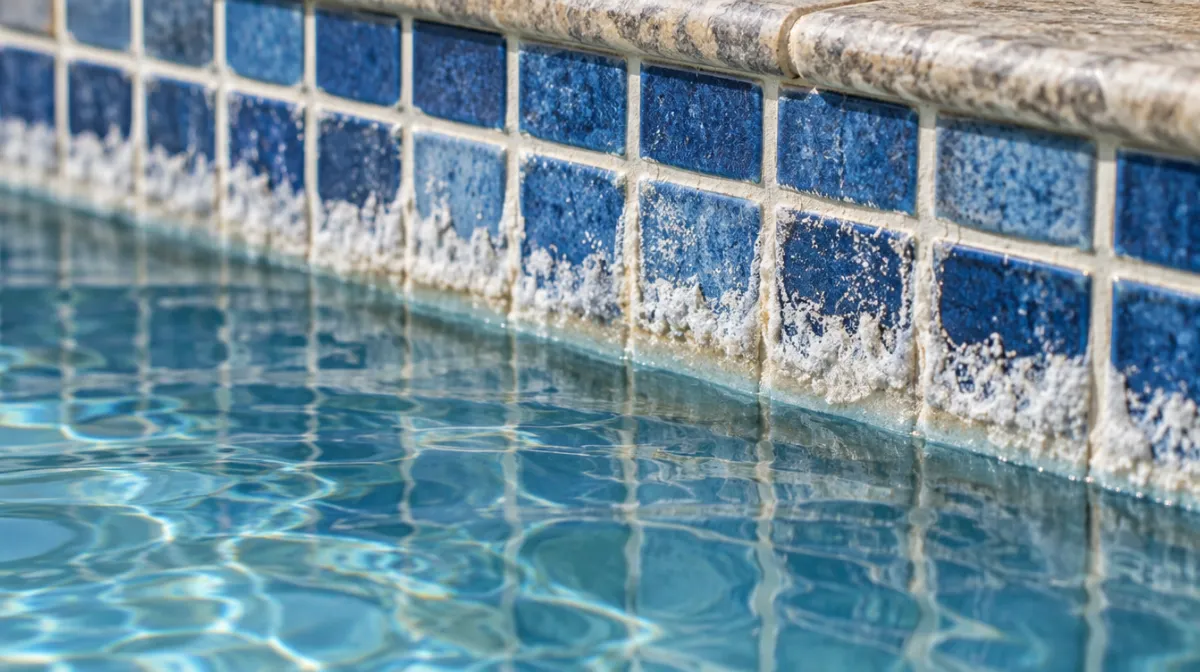
Calcium hardness is the amount of dissolved calcium in your pool water. Plaster, pebble and other cement-based pools commonly run at about 200–400 ppm, so the water doesn’t dissolve calcium out of the surface. Vinyl and fiberglass pools can run lower, often around 150–250 ppm. To raise calcium, add calcium chloride. To lower it, you have to replace some of the water with softer water.
Water tries to reach a balance with the calcium around it.
Calcium doesn’t act alone. Whether water tends to scale or to dissolve depends on pH, total alkalinity, calcium and temperature together. That’s why hot water, in heaters and spas, scales first, and why high pH plus high calcium is the classic cause of cloudy pool water.
| Pool or surface | Commonly recommended calcium hardness | Notes |
|---|---|---|
| Plaster, pebble, quartz aggregate | 200–400 ppm | Many owners aim for 250–350 ppm |
| Vinyl liner | 150–250 ppm | The liner doesn’t need calcium; check your heater manual’s minimum |
| Fiberglass | 150–250 ppm | Follow the shell manufacturer’s range |
| Hot tub | 150–250 ppm | Hot water scales easily; don’t run it high |
See how calcium sits alongside the other readings in our pool chemistry chart. Manufacturers’ ranges take priority, especially for warranties.
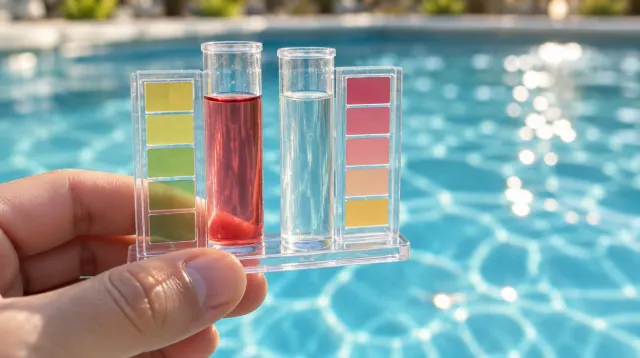
Use a drop-count (titration) test kit for an accurate number; test strips give a rough idea only. Test when you open the pool and every month or so after that, and test your fill water once so you know what every top-up adds. In hard-water areas, evaporation and refilling slowly push calcium up all season. If you get a store test, ask for a saturation index as well: it combines pH, alkalinity, calcium and temperature into one number that shows whether your water leans towards scaling or etching.
Pool calcium increaser is calcium chloride, usually sold as 77–80% flakes or as 94–97% anhydrous pellets.
If your fill water is very soft, you may need calcium increaser after every major refill; note the amount you used so next time is quicker.
Cal-hypo shock adds calcium too, roughly 0.7 ppm of calcium hardness for every 1 ppm of chlorine. If you shock with it often, calcium climbs without you adding any increaser.
There’s no chemical that removes calcium from pool water. The practical options are:
If you can’t replace water yet, reduce scaling by keeping pH at the low end (7.2–7.4) and alkalinity at the low end of its range. Scale inhibitors (sequestrants) help keep calcium dissolved; they don’t lower the reading.
Not directly. But scaling conditions usually mean high pH, and high pH makes chlorine weaker, so balanced calcium supports good sanitation.
Yes. Test it first and adjust your targets: you may never need calcium increaser, and you’ll want to watch for scale as the season goes on.
Monthly is plenty for most pools, plus after refilling or heavy rain. It changes slowly compared with chlorine and pH.

Every article is edited by a human and checked against our editorial policy. Spotted a mistake? Tell us.
Ideal pool chemistry levels in one chart: pH, free chlorine, alkalinity, calcium, stabilizer and salt, plus what to adjust first and a volume calculator.
Work out how many gallons your pool holds in seconds. Free pool volume calculator for rectangle, round and oval pools, plus the formulas and measuring tips.
Why pool pH rises, how to lower it safely with muriatic acid or dry acid, how much to add, and how to stop it creeping back up. Step by step, with safety tips.