How to Fix a Green Pool: A Step-by-Step Guide
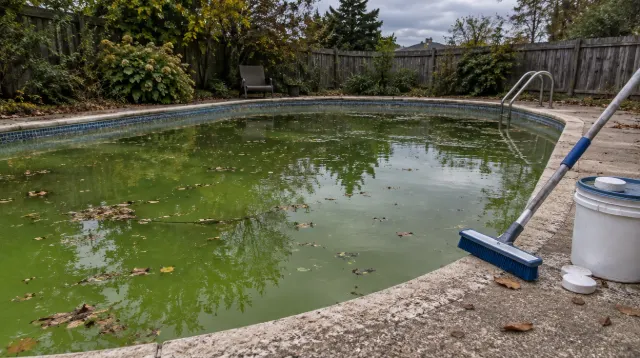
Turn a green pool clear again: test, brush, shock to the right level for your stabilizer, run the filter and vacuum. Doses, timelines and mistakes to avoid.

How to identify and kill black algae: hard brushing, spot treatment, shocking to the right level, filter cleaning and how to stop the spots coming back.
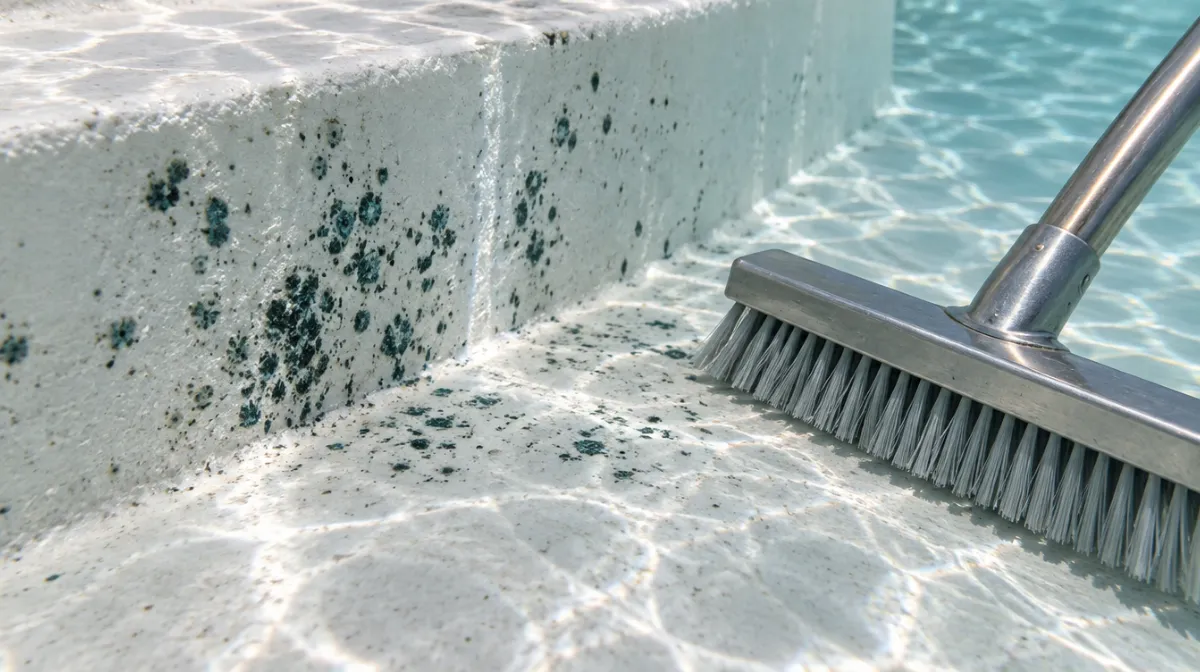
To get rid of black algae, you have to break through its protective layer and then keep chlorine high enough, for long enough, to kill it. In practice that means brushing the spots hard every day, spot-treating them, raising free chlorine to shock level for your stabilizer and holding it there until the spots vanish and the water passes an overnight chlorine test. It usually takes several days, sometimes a couple of weeks.
Black algae is technically a type of cyanobacteria. It looks like:
It grows mostly on plaster, pebble and tile grout, where rough surfaces let it anchor. It’s much rarer on vinyl and fiberglass. If spots on vinyl don’t brush off, they may be stains or metal deposits instead.
| Problem | Color | Brushes off? | Typical location |
|---|---|---|---|
| Black algae | Blue-black spots | Barely | Plaster, grout, shady walls |
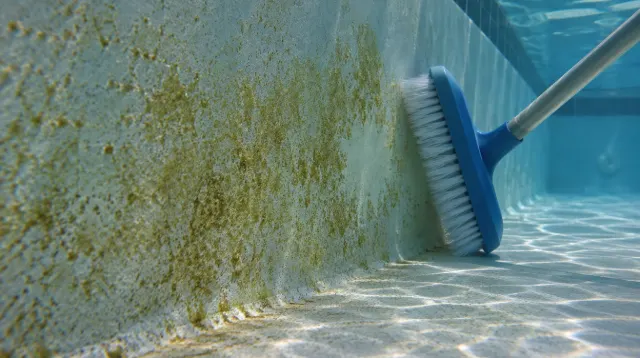
| Mustard algae | Yellow or brownish dust | Easily, then returns | Shady walls and floor |
| Green algae | Green tint or slime | Yes | Everywhere, often the whole pool |
| Metal stains | Brown, black or blue | No | Near fittings or where metals entered |
Black algae builds layers, with a tough outer coating that shields the cells underneath, and its roots grow into tiny pores in plaster. Chlorine that would kill ordinary algae in hours barely touches it unless you break the coating first. That’s why a single shock rarely works: the spots fade, then return. The treatment has to be physical as well as chemical, because neither chlorine nor algaecide reaches the roots until the coating is broken.
Algaecide helps as a follow-up, not a replacement for chlorine and brushing. Copper-based algaecides work well against black algae but can stain plaster and turn blond hair green if overused, so follow the label closely. Polyquat algaecides are gentler and don’t stain. Never add algaecide at the same time as a heavy dose of chlorine unless the label says it’s compatible.
If spots keep returning after several full treatments:
If the whole pool has turned green, not just spotted, start with our step-by-step guide to fixing a green pool.
It isn’t usually considered a major health risk in itself, but it shows your chlorine isn’t keeping up, which means germs may not be controlled either. Stay out during heavy shocking and until chlorine returns to a normal level.
It’s uncommon because vinyl is smooth. Dark spots on vinyl are more often stains, but if they are algae, use a nylon brush and chlorine, never a steel brush or tablets.
Several days for mild cases; two weeks or more for established growth. Keep brushing and holding shock level until the overnight chlorine test passes.

Every article is edited by a human and checked against our editorial policy. Spotted a mistake? Tell us.
Turn a green pool clear again: test, brush, shock to the right level for your stabilizer, run the filter and vacuum. Doses, timelines and mistakes to avoid.
Why pool water turns cloudy and how to clear it: low chlorine, high pH or alkalinity, poor filtration, high calcium, early algae and debris, with fixes.
Yellow, dusty patches that brush away and come back? How to identify and kill mustard algae, clean everything it touches and stop it returning.