Pool Chemistry Basics: The Ideal Levels Chart
Ideal pool chemistry levels in one chart: pH, free chlorine, alkalinity, calcium, stabilizer and salt, plus what to adjust first and a volume calculator.

How much pool shock to add, based on your pool volume, stabilizer level and what you are fixing, with dosing examples for liquid chlorine, cal-hypo and dichlor.
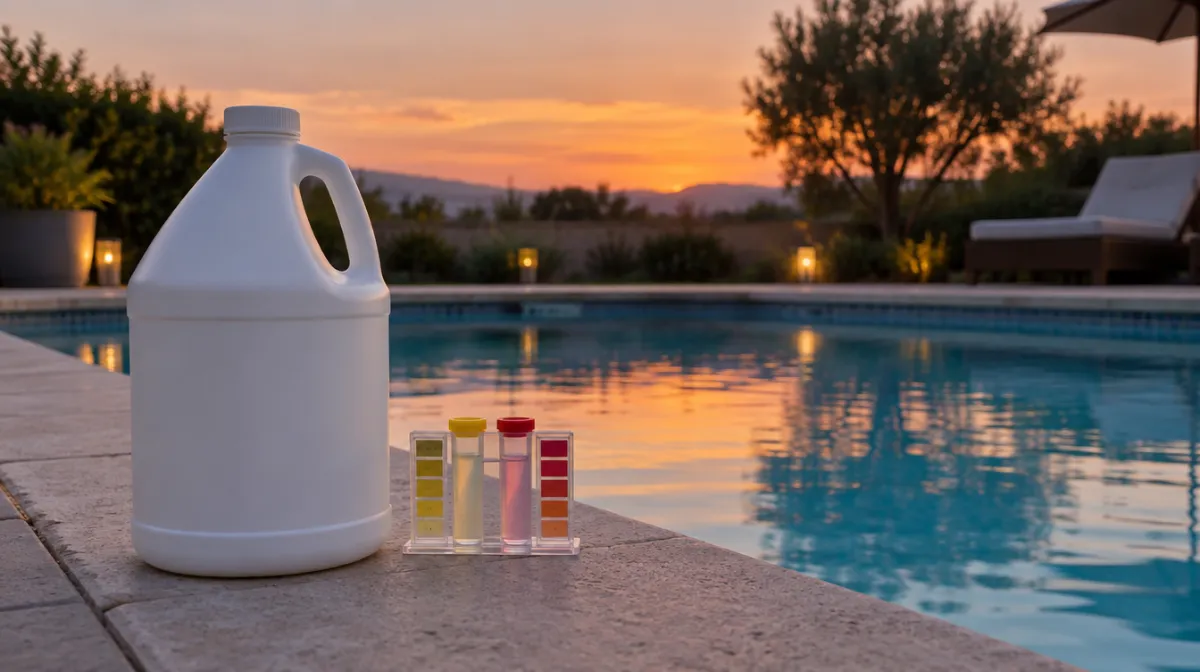
“Shocking” a pool just means adding a large dose of chlorine to break down contaminants, kill algae and clear combined chlorine. The right amount depends on three things: how big your pool is, how much stabilizer is in the water and what you’re trying to fix.
Use our pool volume calculator and test your cyanuric acid (stabilizer). Stabilizer protects chlorine from sunlight but also slows it down, so pools with more stabilizer need a higher shock level. Read more in our cyanuric acid guide.
| Situation | Target free chlorine |
|---|---|
| Routine weekly or after heavy use | About 10 ppm |
| Combined chlorine above 0.5 ppm, cloudy water | About 25% of your CYA level |
| Algae or a green pool | About 40% of your CYA level |
For example, with 40 ppm stabilizer, a green pool needs free chlorine held at around 16 ppm.
| Product | Approximate dose to raise free chlorine by 10 ppm in 10,000 gallons |
|---|---|
| Liquid chlorine, 10% | About 1 gallon |
| Liquid chlorine, 12.5% | About 0.8 gallons |
| Calcium hypochlorite (65–73%) | About 1.3–1.5 lb |
| Dichlor (about 56%) | About 1.5–1.7 lb |
Always check your product label, as strengths vary.
Example: a 20,000-gallon pool with free chlorine at 2 ppm and a target of 12 ppm needs +10 ppm. That’s roughly 2 gallons of 10% liquid chlorine.
Many owners shock weekly in peak season and after storms, parties or heavy use. If you keep free chlorine at the right level for your stabilizer, you may need to shock less often.
Very high chlorine can bleach liners and swimsuits and irritate skin. Stick to the targets above and wait for levels to drop before swimming.
Once free chlorine is back within your normal range, often the next day. Test first.

Every article is edited by a human and checked against our editorial policy. Spotted a mistake? Tell us.
Ideal pool chemistry levels in one chart: pH, free chlorine, alkalinity, calcium, stabilizer and salt, plus what to adjust first and a volume calculator.
Work out how many gallons your pool holds in seconds. Free pool volume calculator for rectangle, round and oval pools, plus the formulas and measuring tips.
Why pool pH rises, how to lower it safely with muriatic acid or dry acid, how much to add, and how to stop it creeping back up. Step by step, with safety tips.