Saltwater vs Chlorine Pools: Costs, Pros and Cons
Saltwater or traditional chlorine? How salt chlorine generators work, upfront and running costs, maintenance, feel of the water, and which suits your pool.

How to vacuum a pool by hand: the equipment you need, priming the hose, filter or waste settings, the right technique, and what to do when suction is weak.
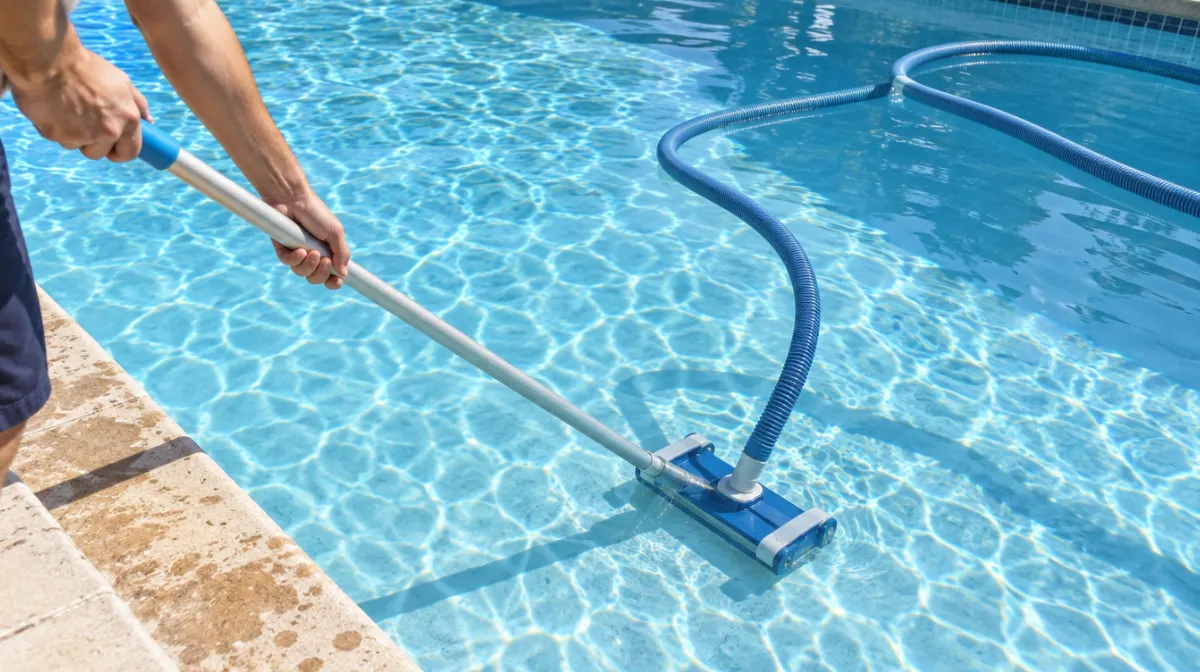
To vacuum a pool manually, attach a vacuum head to a telescopic pole and hose, fill the hose with water to push out the air, connect it to the skimmer or suction port, and move the head slowly across the floor in long, overlapping strokes. Use the filter setting for everyday dirt and the waste setting for algae, fine silt or flocculant, then clean the filter and top up the water.
| Setting | Use it for | What happens |
|---|---|---|
| Filter | Normal dirt, sand and debris | Water passes through the filter and returns to the pool |
| Waste | Dead algae, fine silt, flocculant, heavy dirt | Water bypasses the filter and goes out to drain; the level drops |
| Cartridge filters | No waste setting on most | Vacuum on filter and clean the cartridge afterwards |
Sand and DE filters usually have a multiport valve with both settings. With a cartridge filter, heavy debris can clog the cartridge quickly, so check the pressure gauge as you go. Our guide to sand, cartridge and DE filters explains what each filter can handle.
Vacuum to waste after you’ve killed algae, when the floor is covered in fine silt that would pass through the filter, or after using a flocculant to clear cloudy pool water. Because every gallon goes out to drain, work steadily, keep an eye on the water level and stop before it falls below the skimmer. For a pool recovering from algae, our guide to fixing a green pool explains when to vacuum and when to wait.
A robotic pool cleaner can handle most routine cleaning and uses its own filter, so it doesn’t load your main one. Manual vacuuming is still worth knowing for spot clean-ups, vacuuming to waste and corners that automatic cleaners miss.
Usually air in the hose, full baskets, a dirty filter or a low water level. Re-prime the hose, empty the baskets and check the filter pressure.
Filter for normal dirt; waste for fine silt, dead algae or flocculant that would pass through or clog the filter.
Once a week is typical, more often after storms, heavy use or an algae treatment.

Every article is edited by a human and checked against our editorial policy. Spotted a mistake? Tell us.
Saltwater or traditional chlorine? How salt chlorine generators work, upfront and running costs, maintenance, feel of the water, and which suits your pool.
Sand, cartridge and DE pool filters compared: how fine they filter, cleaning, water use, cost and lifespan, plus how to tell when your filter needs attention.
What to look for in a robotic pool cleaner: wall and waterline cleaning, filtration, navigation, cable or cordless, maintenance and warranty.