Pool Chemistry Basics: The Ideal Levels Chart
Ideal pool chemistry levels in one chart: pH, free chlorine, alkalinity, calcium, stabilizer and salt, plus what to adjust first and a volume calculator.

Free pool chemical calculator: how much liquid chlorine, cal-hypo, muriatic acid, soda ash, baking soda, stabilizer or calcium chloride to add for your volume.
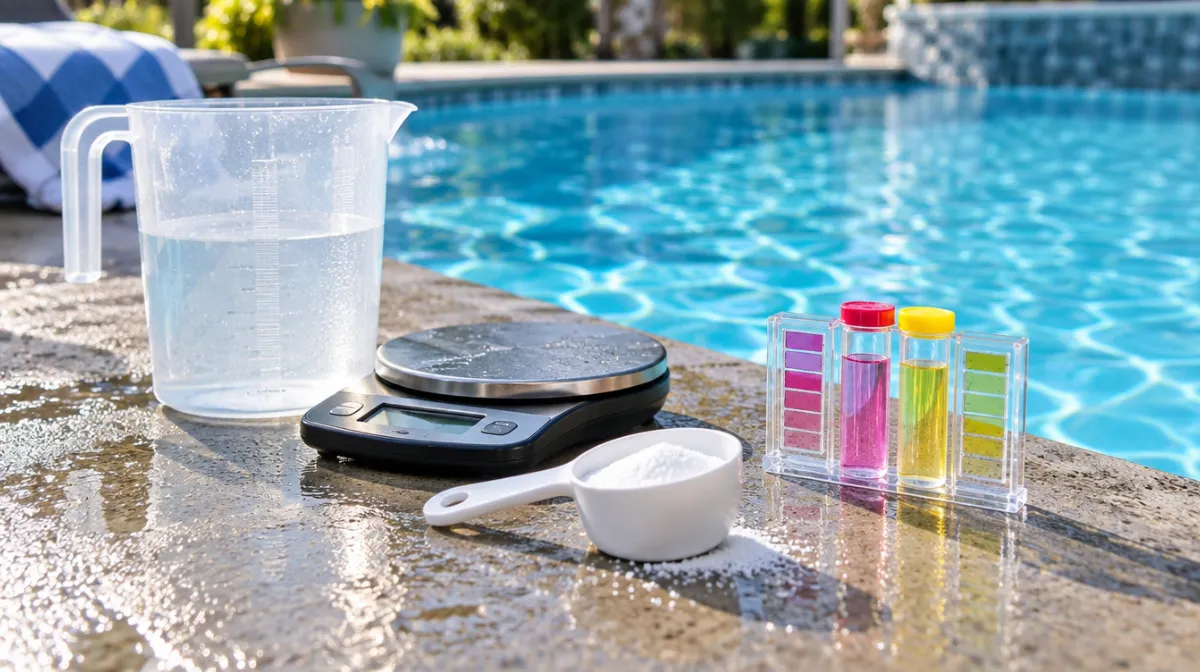
To work out how much of a pool chemical to add, you need your pool volume in gallons, your current test reading and the reading you want. The calculator below does the math for liquid chlorine, cal-hypo, muriatic acid, soda ash, baking soda, stabilizer and calcium chloride. Treat every result as an estimate: add part of it, let the pump circulate the water, retest and then top up.
Enter your pool volume and your latest test results. Doses are estimates for the product strengths shown on common labels.
Most pool chemicals behave predictably. Raising a reading by 1 ppm means adding 1 milligram of the active ingredient for every liter of water, so the dose is simply the change you need, multiplied by your volume and by a factor for each product. Liquid chlorine is sold at different strengths (household bleach is often 6–8%, pool chlorine 10–12.5%), so the calculator asks for the percentage on your label.
pH is different. Total alkalinity buffers pH, so the amount of acid or soda ash needed depends on how much buffer is in the water. For those two options, the calculator uses standard carbonate chemistry, adjusted for stabilizer (cyanuric acid also buffers a little). It ignores borates, so if you use a borate product, expect to need more acid than it shows.
| Goal | Product | Approximate amount |
|---|---|---|
| Raise free chlorine by 1 ppm | Liquid chlorine, 10% | 12.8 fl oz |
| Raise free chlorine by 1 ppm | Liquid chlorine, 12.5% | 10.2 fl oz |
| Raise free chlorine by 1 ppm | Cal-hypo, 65% | 2.1 oz by weight |
| Raise total alkalinity by 10 ppm | Baking soda | 1.4 lb |
| Raise stabilizer by 10 ppm | Cyanuric acid granules | 13.4 oz by weight |
| Raise calcium hardness by 10 ppm | Calcium chloride, 77–80% | 1.2 lb |
| Lower or raise pH | Muriatic acid or soda ash | Depends on alkalinity: use the calculator |
Scale these up or down for your own volume. If you don’t know it, our pool volume calculator takes a minute, and a wrong volume is the most common reason doses miss.
Chemicals interact, so the order matters:
For chlorine, alkalinity, stabilizer and calcium, the math is exact for the stated product strength; the uncertainty comes from your volume, your test and the product’s real strength (liquid chlorine loses strength as it ages). For acid and soda ash, results are estimates, which is why the calculator suggests adding about three-quarters first.
No. Add one at a time and let it circulate before the next. Never add chlorine and acid together, and never premix products in the same bucket.
Usually the volume estimate is off, the chemical hasn’t fully circulated or dissolved, or the product was weaker than its label (old liquid chlorine is the classic example). Retest, note the difference and adjust your volume or strength for next time.

Every article is edited by a human and checked against our editorial policy. Spotted a mistake? Tell us.
Ideal pool chemistry levels in one chart: pH, free chlorine, alkalinity, calcium, stabilizer and salt, plus what to adjust first and a volume calculator.
Work out how many gallons your pool holds in seconds. Free pool volume calculator for rectangle, round and oval pools, plus the formulas and measuring tips.
Why pool pH rises, how to lower it safely with muriatic acid or dry acid, how much to add, and how to stop it creeping back up. Step by step, with safety tips.