Pool Chemistry Basics: The Ideal Levels Chart
Ideal pool chemistry levels in one chart: pH, free chlorine, alkalinity, calcium, stabilizer and salt, plus what to adjust first and a volume calculator.

How to lower high total alkalinity in a pool with acid and aeration, how much acid it takes, how long it lasts, and how to stop alkalinity climbing back up.
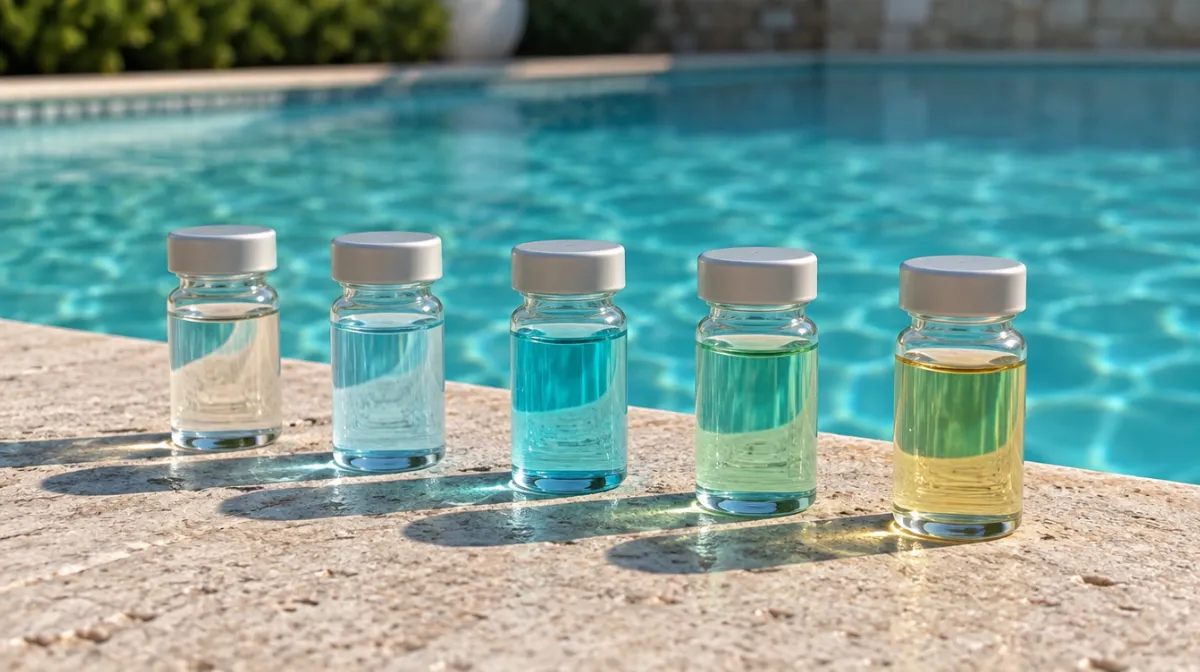
The practical way to lower total alkalinity in a pool is to combine acid with aeration. Acid lowers both pH and alkalinity; aeration then raises pH again without adding alkalinity back. Repeat the cycle until alkalinity reaches your target, usually 80–120 ppm, then set pH to 7.4–7.6. It takes patience, often several days, but it works in every pool.
Total alkalinity is your pH buffer. Some is essential, but too much keeps pushing pH upward:
| Step | Effect on pH | Effect on alkalinity |
|---|---|---|
| Add acid | Down | Down |
| Aerate | Up | No change |
| Net result of each cycle | Back where it started | Lower |
Acid converts some of the buffer (bicarbonate) into dissolved carbon dioxide. Aeration drives that carbon dioxide out of the water, which lets pH rise again without restoring the buffer.
As a guide, about 26 fl oz (roughly 0.77 liters) of 31.45% muriatic acid lowers alkalinity by about 10 ppm in 10,000 gallons. Going from 160 to 100 ppm in a 15,000-gallon pool therefore takes roughly 1.8 gallons (about 7 liters) in total. You add that amount over several rounds, because each round is limited by how low pH can safely go. Dry acid (sodium bisulfate) works too; follow the label for its equivalent dose.
Each cycle removes a modest amount of alkalinity, and aeration can take a day or more to bring pH back up. Lowering alkalinity by 40–60 ppm commonly takes a week or so, faster if you have strong water features. A pool with little splashing will be slower. Keep a simple log of each round (date, acid added, pH and alkalinity) so you can see the trend and avoid overshooting.
Some guides say pouring acid in one spot with the pump off “targets” alkalinity rather than pH. The total amount of acid you add is what lowers alkalinity, so pour it as you normally would, safely and with circulation, and rely on aeration to do the rest.
Yes, temporarily. The acid lowers pH along with alkalinity. Aeration then brings pH back up while alkalinity stays down.
Wait until the acid has circulated fully and pH is in a comfortable range (not below 7.0), and follow the product label. Many owners dose in the evening and aerate overnight.
Only by dilution: draining part of the water and refilling with lower-alkalinity water. That works if your fill water is better, but it wastes water and changes all your other readings.

Every article is edited by a human and checked against our editorial policy. Spotted a mistake? Tell us.
Ideal pool chemistry levels in one chart: pH, free chlorine, alkalinity, calcium, stabilizer and salt, plus what to adjust first and a volume calculator.
Work out how many gallons your pool holds in seconds. Free pool volume calculator for rectangle, round and oval pools, plus the formulas and measuring tips.
Why pool pH rises, how to lower it safely with muriatic acid or dry acid, how much to add, and how to stop it creeping back up. Step by step, with safety tips.