Saltwater vs Chlorine Pools: Costs, Pros and Cons
Saltwater or traditional chlorine? How salt chlorine generators work, upfront and running costs, maintenance, feel of the water, and which suits your pool.

Why variable-speed pool pumps use far less electricity, how much you might save, how to program one, and what to check before you buy or replace a pump.
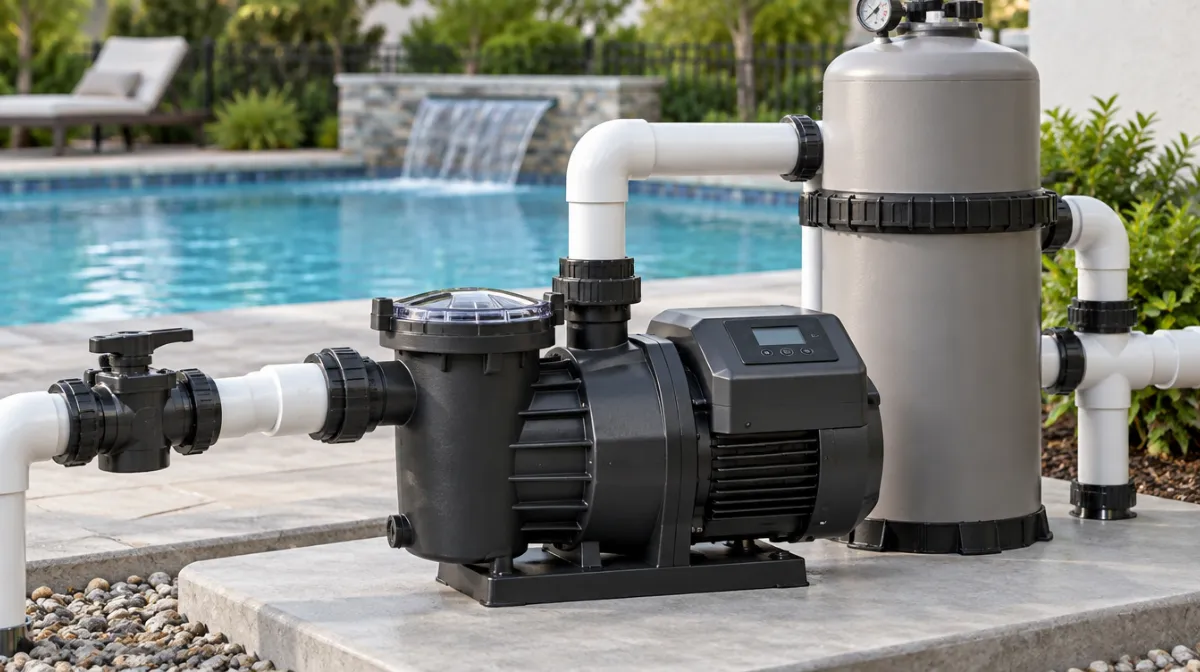
Yes, for most pools the savings from a variable-speed pump are real, and often large. A pump running at half speed moves about half the water but uses only a fraction of the power, so running slowly for longer filters the same water for much less electricity. ENERGY STAR says a certified in-ground pool pump can use up to 65% less energy than a standard pump and save up to $450 a year. How much you actually save depends on your electricity price, your pool and, above all, how you program the pump.
Pumps follow what engineers call the affinity laws. Flow rises in step with speed, but the power needed rises roughly with the cube of speed. Halve the speed and, in theory, you get half the flow for about one-eighth of the power. The physics behind this is the same relationship between work, energy and power that governs any motor.
| Pump speed | Approximate flow | Theoretical power |
|---|---|---|
| 100% | 100% | 100% |
| 75% | 75% | 42% |
| 50% | 50% | 13% |
| 33% | 33% | 4% |
Real pumps don’t quite match the theory because of motor losses and plumbing resistance, but the pattern holds: eight hours at half speed moves the same water as four hours at full speed for a fraction of the energy. A single-speed pump can’t do this; it runs flat out whenever it’s on.
Some jobs genuinely need high flow, and while they run you lose part of the advantage:
Even so, most pools can spend most of the day at low speed, with short high-speed periods only when needed. Automation helps: many variable-speed pumps can change speed on a schedule or when a heater calls for flow, so you don’t have to remember.
Slow water gives filters more time to trap fine particles. ENERGY STAR notes that slower filtration rates put less strain on filters and plumbing. Our comparison of sand, cartridge and DE filters explains how each filter behaves at different flow rates.
| Time | Speed | Purpose |
|---|---|---|
| Overnight (off-peak rates) | Low | Main filtration and circulation |
| Mid-morning, 1–2 hours | Medium to high | Skimming leaves, running a cleaner |
| During heating | As the heater requires | Minimum flow for the heater |
| Evening | Low | Keep water moving; skimmers working |
Start with a long, low-speed block and adjust: if the skimmers stop pulling debris or the water looks dull, raise the speed slightly or add an hour. The goal is the lowest speed that keeps the pool clear.
If your single-speed pump still works, the decision is about money. Estimate its yearly running cost (watts × hours per day × days in season ÷ 1,000 × your price per kWh), then do the same for a low-speed schedule using the new pump’s rated wattage at that speed. Pools that run many hours a day, over long seasons or with high electricity prices usually pay back fastest. If your old pump is noisy, leaking or failing, replacing it now avoids a rushed purchase later.
In the United States, federal efficiency standards for pool pumps took effect in July 2021, and in practice most replacement filter pumps for in-ground pools are now variable-speed models. Many utilities offer rebates on ENERGY STAR certified pumps; check your utility or the ENERGY STAR rebate finder before you buy.
Many owners run them far longer than a single-speed pump, often 12 to 24 hours at low speed, because the energy cost is so low. Aim for at least one full turnover of your pool volume a day, then adjust to keep the water clear.
They save a lot compared with single-speed pumps, but they’re less flexible than variable-speed pumps, which let you fine-tune the flow for each task.
At low speed they’re usually much quieter than single-speed pumps, often barely audible from a few feet away.

Every article is edited by a human and checked against our editorial policy. Spotted a mistake? Tell us.
Saltwater or traditional chlorine? How salt chlorine generators work, upfront and running costs, maintenance, feel of the water, and which suits your pool.
Sand, cartridge and DE pool filters compared: how fine they filter, cleaning, water use, cost and lifespan, plus how to tell when your filter needs attention.
What to look for in a robotic pool cleaner: wall and waterline cleaning, filtration, navigation, cable or cordless, maintenance and warranty.